
Cooking Grease Film
Kitchen floor degreasing breaks up oily residue near cook lines, fry stations, ranges, and other areas exposed to airborne grease.
Serving Portland, Oregon & surrounding areas
Open 24/7
Professional degreasing for restaurant tile and grout, scheduled around service hours and tailored to the condition of your kitchen floor.
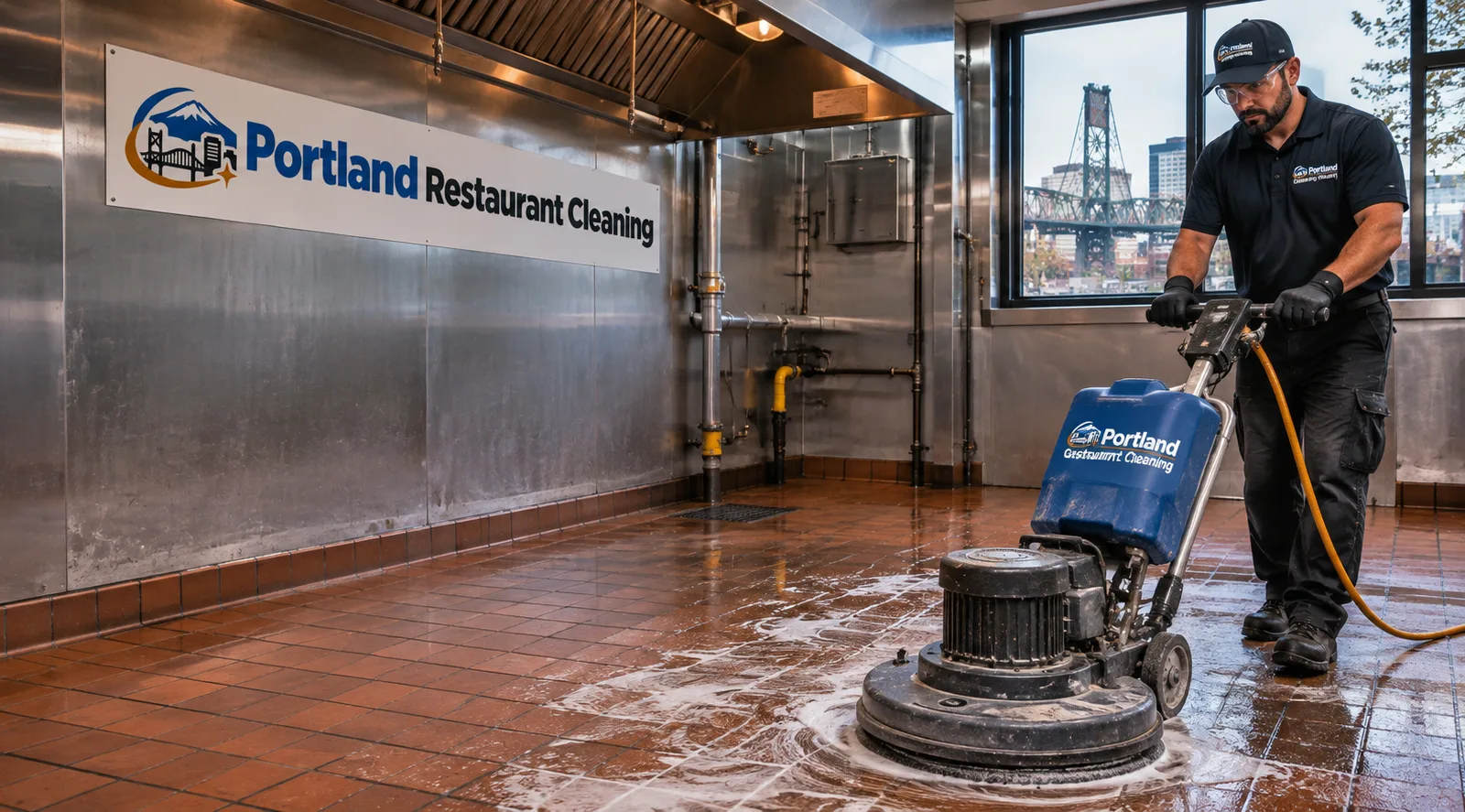
Commercial Kitchen Floor Cleaning targets the grease film, embedded soil, food residue, and tracked-in grit that routine mopping can leave on tile and grout. Portland Restaurant Cleaning evaluates the floor material, buildup, drainage, equipment access, and operating schedule before recommending a cleaning plan. With experience as a professional restaurant service company in Portland, OR, we perform the work with attention to active kitchen conditions rather than treating the floor like an ordinary commercial surface.
Restaurant floors collect different soils in different zones. Aerosolized cooking oil can settle near fryers and ranges. Prep areas may carry organic residue, while receiving doors introduce grit that can abrade the finish. Grease and soil also gather along equipment edges, beneath movable racks, around floor drains, and in recessed grout joints. Effective cleaning requires the right chemistry, dwell time, agitation, soil recovery, and rinsing for each area.
A professional cleaning complements daily sweeping and mopping. It does not replace a restaurant's regular sanitation procedures, spill response, or required cleaning schedule. Instead, it provides periodic corrective cleaning for buildup that ordinary tools are no longer removing well.
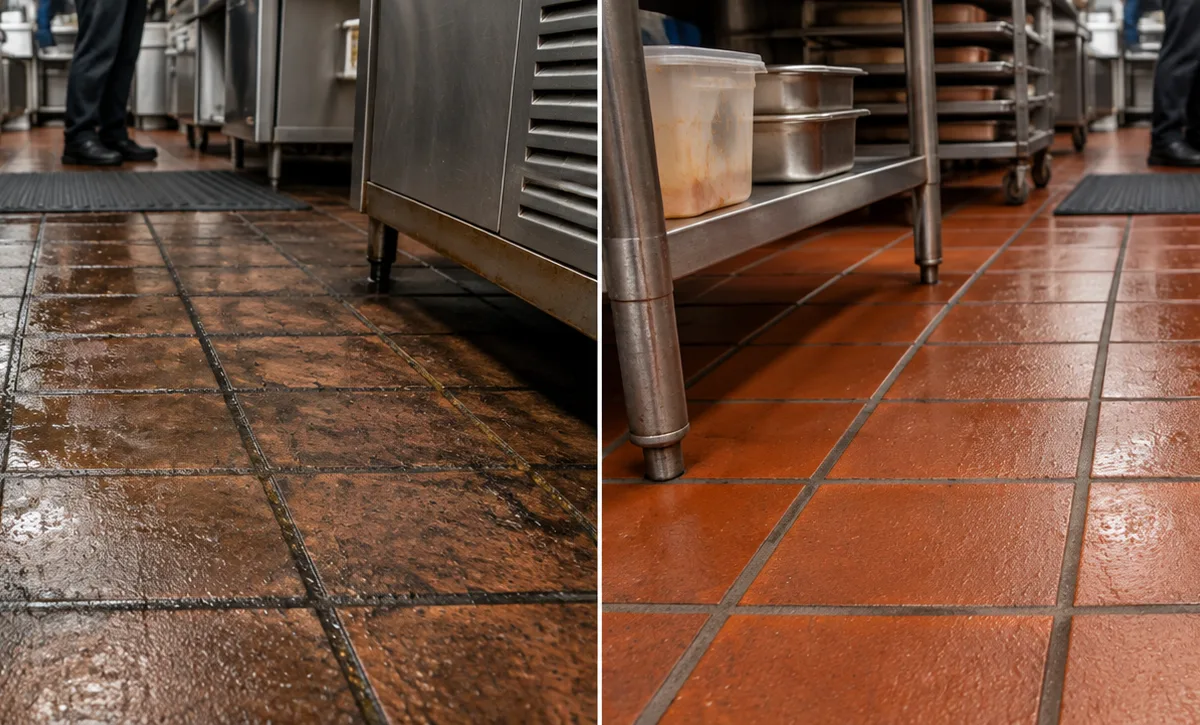
Quarry tile is common in commercial kitchens because it is durable, but its textured surface and numerous grout joints can hold greasy soil. Ceramic tile, porcelain tile, sealed concrete, epoxy flooring, and resilient commercial flooring have different limits. The cleaner, agitation method, water volume, and recovery process must suit the actual surface.
Restaurant tile cleaning usually begins with dry soil removal, followed by application of a compatible degreaser. The product needs enough dwell time to loosen bonded grease without drying on the floor. Mechanical agitation works the solution into textured tile and low grout lines. The suspended soil is then recovered rather than pushed into corners or drains, and the floor is rinsed as needed to remove cleaner residue.
Restaurant grout cleaning may require focused agitation because grout joints sit lower than the tile face and collect dark residue. Existing grout condition matters. Cracked, missing, or badly deteriorated joints are maintenance issues, not stains, and cleaning cannot repair them. Our team identifies those limitations before work begins so the cleaning scope is clear.
Kitchen floor degreasing breaks up oily residue near cook lines, fry stations, ranges, and other areas exposed to airborne grease.
Focused brushing and compatible chemistry loosen embedded residue in sound grout without treating damaged joints as a cleaning problem.
Detail work targets buildup along walls, beneath accessible movable items, around table legs, and at equipment perimeters.
Dry soil and abrasive particles brought through receiving and exterior doors are removed before wet cleaning begins.
Appropriate rinsing and recovery remove suspended soil and leftover chemistry rather than allowing it to dry back onto the floor.
Recurring service can be based on cooking volume, floor condition, trouble spots, and the restaurant's available cleaning window.
Step 1 of 6
We identify the floor material, grease concentration, grout condition, drains, transitions, damaged areas, and equipment that can be moved safely. We also discuss kitchen access and the time available before the area must return to use.
Step 2 of 6
Loose floor items are cleared, and the cleaning route is planned around fixed equipment. Staff should remove food, utensils, portable appliances, mats, and unsecured items before service unless another arrangement is included in the scope.
Step 3 of 6
A product suited to the floor and soil is applied at the appropriate dilution. Controlled dwell time helps release grease, but the solution is not allowed to dry on the surface.
Step 4 of 6
Commercial equipment and detail brushes work the cleaning solution across textured surfaces, grout lines, corners, and accessible equipment edges. Agitation is adjusted where joints or flooring show wear.
Step 5 of 6
Liquefied grease, dirty solution, and loosened debris are collected with suitable recovery equipment. Rinsing is performed where needed so remaining chemistry does not leave a film.
Step 6 of 6
The cleaned area is checked for remaining trouble spots and obvious maintenance concerns. The floor needs adequate drying time before normal traffic resumes, and timing depends on ventilation, flooring, and site conditions.
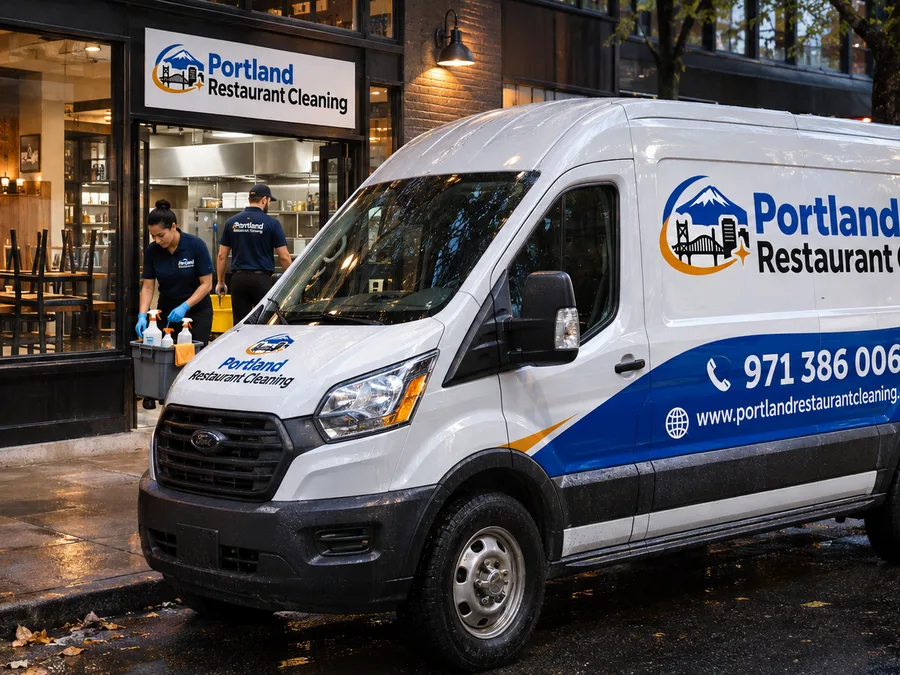
Portland restaurants operate in a wide range of buildings and service patterns, so access planning is part of the job. Downtown kitchens may have loading constraints, compact back-of-house layouts, and fixed equipment with narrow cleaning paths. The Pearl District combines restaurants with mixed-use buildings where timing and shared access can matter. In the Central Eastside, older commercial buildings can have floor transitions, patched grout, or irregular areas that require closer inspection before machine cleaning.
Mississippi Avenue and the Alberta Arts District have many storefront restaurants with busy dining periods and limited room for staging equipment. Service is planned around the actual kitchen shutdown window, not an assumed schedule. Wet Portland weather also increases the grit and moisture carried through delivery and staff entrances. Entry mat maintenance and frequent dry soil removal help keep that abrasive material from spreading across kitchen tile.
Our base at SE Washington Street places Portland Restaurant Cleaning in the Central Eastside, with restaurant floor cleaning provided across Portland. Before scheduling, we confirm access, water availability, floor area, equipment restrictions, and the time by which the kitchen must be ready for staff.
Commercial kitchen floor cleaning in Portland typically costs about $350 to $1,200 per visit, while large kitchens, severe grease buildup, or extensive detail work may cost more. Smaller accessible floors with light buildup generally fall toward the lower end.
Final pricing depends on cleanable square footage, flooring material, grease level, grout condition, equipment access, floor drains, preparation, parking, and the available service window. Recurring restaurant floor degreasing may be priced differently from a one-time corrective cleaning. The exact cost is confirmed after an inspection and scope review.
A good result starts before cleaning equipment reaches the floor. Food and food-contact items should be protected or removed from the work zone. Staff need a clear plan for shutting down nearby activity, moving approved items, and keeping people off wet surfaces. If the kitchen has alarms, access controls, loading restrictions, or shared building areas, those details should be discussed during scheduling.
Cleaning frequency is based on use rather than a fixed rule. A high-volume fry operation may need restaurant floor degreasing more often than a kitchen with limited oil exposure. The right interval also depends on daily cleaning quality, grout depth, floor texture, ventilation, and how quickly grease film returns. We can recommend a practical interval after seeing the floor through normal operating conditions.
Floor cleaning has limits. It will not repair loose tile, failed grout, damaged coatings, poor drainage, or a floor whose texture has worn smooth. It also cannot guarantee that every old discoloration will disappear. A written scope should distinguish removable soil from wear, staining, and physical damage before service begins.
Describe your kitchen floor, grease trouble spots, approximate cleanable area, and preferred service window so we can prepare a clear scope for the work.
Call for a Free QuoteA typical service takes several hours, but the working time and drying time depend on floor area, grease buildup, equipment access, and the number of detailed edges or grout lines. Compact Portland kitchens can take longer per square foot when fixed equipment creates narrow cleaning paths. Scheduling should include enough time for cleaning, recovery, inspection, and drying before staff return.
Yes, service can be planned around an after-hours access window when scheduling and building access allow it. We need to know when cooking stops, when staff finish preparation, how entry will be provided, and when the floor must be ready again. Restaurants in mixed-use buildings should also confirm any loading, noise, or shared-access restrictions.
Yes, sound quarry tile and grout can be cleaned with compatible degreasing chemistry, controlled dwell time, agitation, and soil recovery. Cracked tile, missing grout, and failed joints cannot be corrected through cleaning. Those conditions are documented so the restaurant can separate cleaning needs from repair work.
Degreasing can remove oily film and cleaner residue that contribute to poor traction, but it cannot correct worn texture, damaged flooring, standing water, drainage problems, or new spills. Slip resistance depends on the floor material and ongoing maintenance as well as cleanliness. Kitchen staff should continue prompt spill response and follow the facility's safety procedures.
Remove food, utensils, floor mats, portable equipment, boxes, and other unsecured items from the cleaning area. Identify which racks or equipment may be moved, keep staff out of active work zones, and provide the agreed access to water and the kitchen. Fixed gas, electrical, refrigeration, or plumbed equipment should not be moved unless qualified personnel have approved the work.
The interval should be based on how quickly bonded grease returns after proper daily maintenance. Cooking volume, fryer use, floor texture, grout condition, foot traffic, and entry grit all affect the schedule. Portland's wet-season traffic can increase tracked-in moisture and grit, while grease concentration is usually highest near cooking equipment. An initial cleaning provides a useful baseline for setting recurring visits.
No, cleaning removes removable soil but cannot promise removal of permanent stains, worn surfaces, grout discoloration, chemical damage, or absorbed oil. A test area can help show how the floor responds before the full service. The pre-service inspection also identifies damage and staining that are likely to remain.
Tell Portland Restaurant Cleaning about the floor material, current buildup, access conditions, and operating schedule. We will help define the cleaning scope and a practical service window.