
Cookline and Equipment Exteriors
Degreasing for ranges, fryers, grills, ovens, hot lines, equipment sides, legs, casters, and accessible spaces beneath movable units.
Serving Portland, Oregon & surrounding areas
Open 24/7
Detailed cleaning for cooking equipment, exhaust systems, floors, walls, prep areas, and other hard-working surfaces, scheduled around your operating hours.
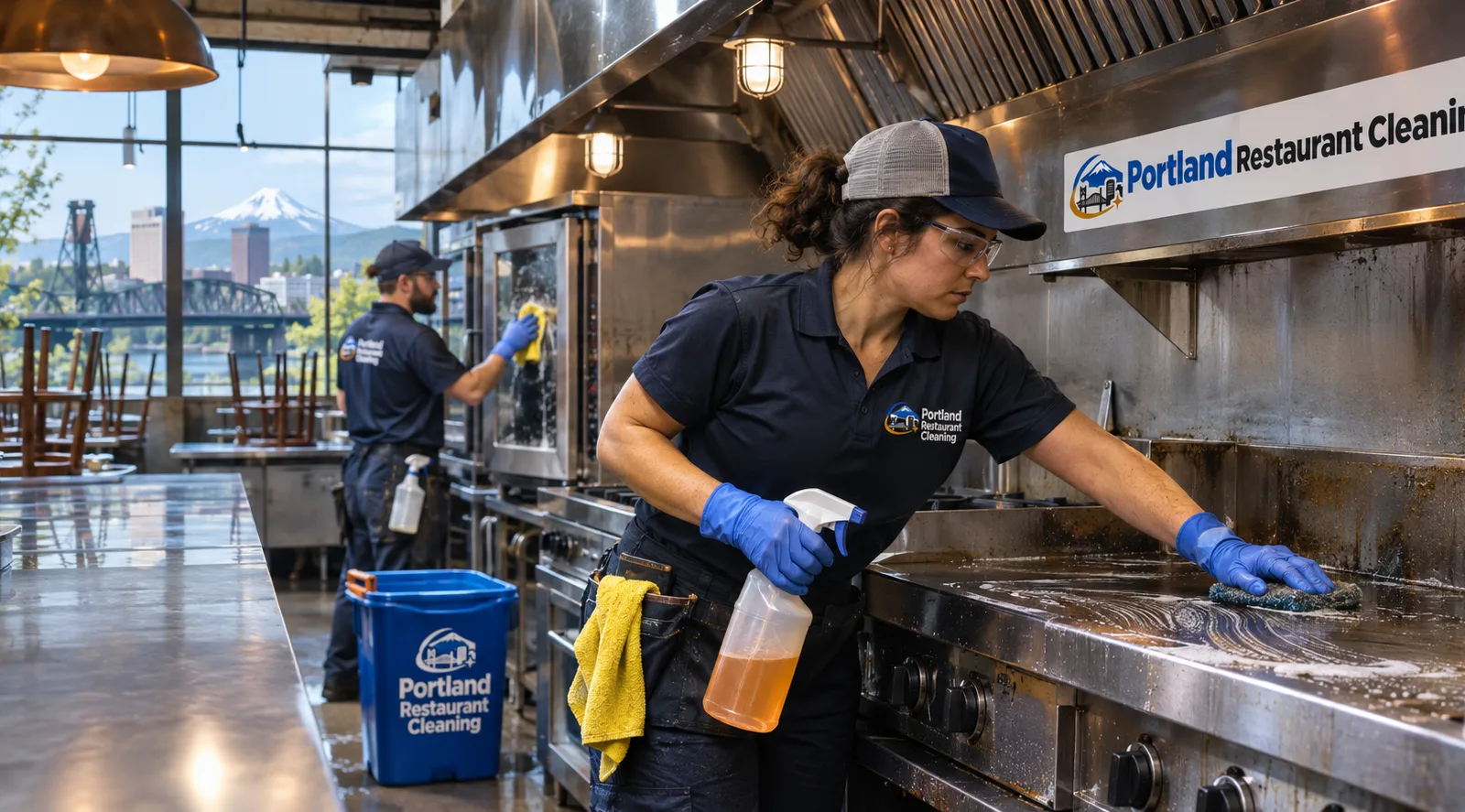
Commercial Kitchen Cleaning Services address the grease, carbon, food residue, and buildup that routine closing duties may leave behind. Portland Restaurant Cleaning develops the scope around your equipment, operating schedule, access limits, and priority areas. That can mean a focused equipment clean, recurring kitchen service, or a planned deep cleaning before an inspection, reopening, or change in management.
As Portland's trusted restaurant service team, we work methodically through agreed areas while respecting food-contact surfaces, sensitive controls, and the need to return the kitchen in an orderly condition. Before work begins, we clarify what is included, which equipment must be cool or moved, who handles disassembly, and when the space needs to be ready for service.
Our location at 88 SE Washington St, Suite 4 places the team near Portland's Central Eastside, where restaurants often operate in mixed commercial buildings with loading, parking, and after-hours access considerations. Those practical details belong in the cleaning plan. A useful scope should identify the work zones, site access, timing, exclusions, and any preparation expected from kitchen staff.
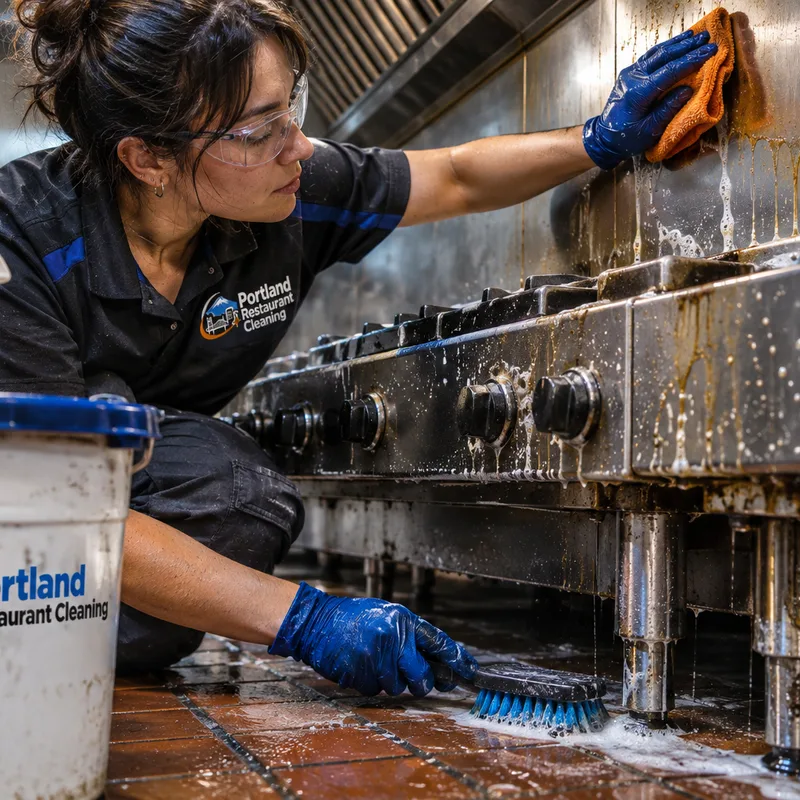
A commercial kitchen deep cleaning is built around the facility rather than a generic room checklist. Common work areas include cooklines, stainless steel surfaces, backsplashes, prep tables, sinks, shelving, walls, washable ceilings, doors, floor edges, and spaces beneath or behind movable equipment. Degreasing may also be needed on fryers, ovens, ranges, grills, flat tops, refrigeration exteriors, casters, legs, and equipment sides.
Kitchen equipment cleaning requires care. Electrical controls, pilot assemblies, burners, insulation, seals, and manufacturer-restricted components should not be flooded or treated like ordinary stainless steel. Food-contact surfaces also need products and procedures appropriate to their use, followed by the required rinse or finishing steps. Cleaning and sanitizing are different tasks: cleaning removes soil, while sanitizing is performed on an already cleaned surface using the correct product, concentration, and contact time.
The scope can include floor degreasing, detail work along coves and grout lines, and attention to floor-wall junctions where residue collects. Fixed equipment, heavy appliances, inaccessible utility connections, and internal components may require special arrangements. We identify those limits before scheduling so the crew and kitchen manager share the same expectations.
Degreasing for ranges, fryers, grills, ovens, hot lines, equipment sides, legs, casters, and accessible spaces beneath movable units.
Cleaning for stainless steel tables, sinks, shelving, splash areas, washable walls, doors, and other surfaces included in the agreed scope.
Removal of grease and embedded soil from accessible flooring, corners, edges, coves, and floor-wall junctions, with attention to slip-prone residue.
Detail cleaning for doors, handles, gaskets where appropriate, tops, sides, and accessible areas around coolers and freezers.
Restaurant hood cleaning is scoped separately because filters, plenums, ducts, and rooftop fans require access and procedures beyond ordinary surface degreasing.
Targeted service for new operators, management transitions, post-maintenance resets, and kitchens preparing to resume production.
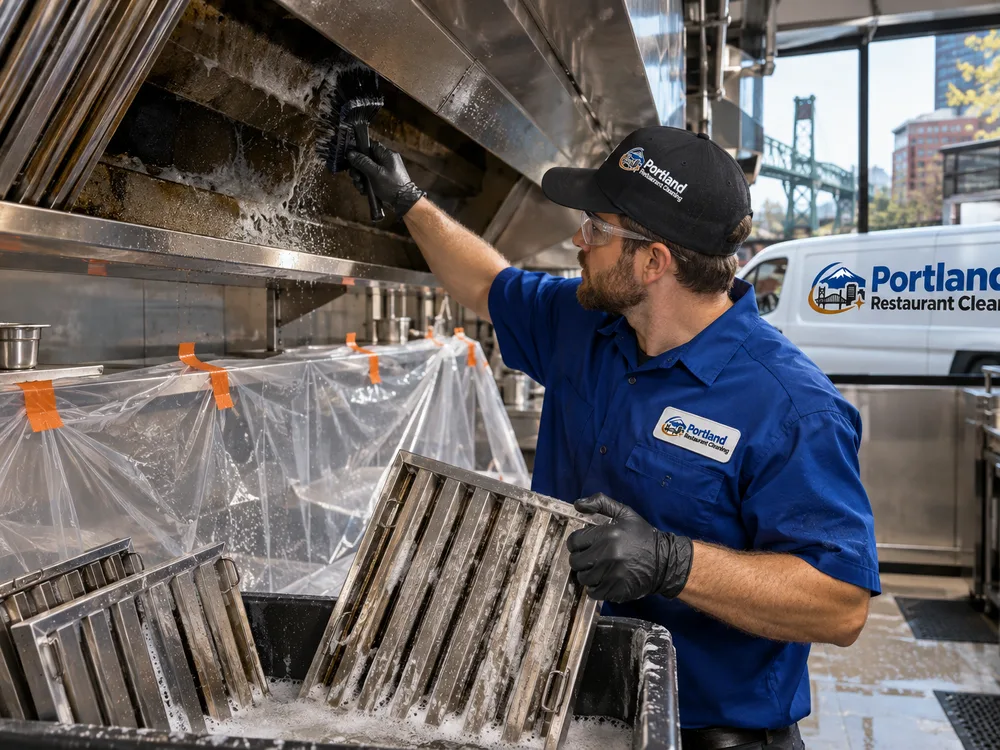
Restaurant hood cleaning in Portland should be evaluated as an exhaust-system job, not as wiping the visible canopy. Grease can accumulate on removable filters, within accessible plenum areas, through ductwork, and at the exhaust fan. The proper scope depends on the system configuration, cooking volume, fuel and cooking methods, access panels, rooftop access, and the condition found during inspection.
A request for restaurant hood cleaning in Portland, Oregon should identify whether the quote includes the hood canopy, filters, plenum, accessible ductwork, fan components, containment, and cleanup. Roof access and protection also matter, particularly when a building has shared access or property-management requirements. NFPA 96 is the nationally recognized standard concerning ventilation control and fire protection for commercial cooking operations. Cleaning frequency is not one universal interval; it depends on the type and volume of cooking and the requirements that apply to the operation.
Visible canopy cleaning can improve appearance, but it does not establish that the complete exhaust path has been cleaned. A clear proposal distinguishes surface work from full-system service and records areas that could not be accessed.
Step 1 of 5
We discuss the kitchen layout, equipment, operating hours, access, current condition, priority concerns, and whether exhaust-system work is part of the request.
Step 2 of 5
The work plan identifies included surfaces and equipment, preparation duties, access requirements, exclusions, and the expected service window.
Step 3 of 5
Kitchen staff may need to cool equipment, remove food and small wares, secure sensitive items, and provide access. The crew establishes containment and protects adjacent areas as needed.
Step 4 of 5
Cleaning proceeds by work zone using methods suited to the soil and surface. The crew pays close attention to edges, joints, equipment bases, and other accessible collection points.
Step 5 of 5
The cleaned areas are reviewed against the agreed scope. Any access issue or condition that limited the work is documented before the kitchen is returned.
Portland kitchens vary widely in layout and access. The cleaning plan should reflect the property, service window, and practical route into each work area.
In the Central Eastside, a restaurant may occupy a converted commercial building where loading arrangements, shared corridors, or rooftop access affect setup. Downtown kitchens may require careful scheduling around building access and limited loading space. In the Pearl District, mixed-use buildings can add property-management rules for service access, elevators, and after-hours work.
Alberta Arts District restaurants often rely on compact footprints, so staging equipment and cleaning one zone at a time may be more practical than clearing the entire kitchen. Along North Mississippi Avenue, evening-focused operations may favor overnight or early-morning service windows. We confirm conditions at each property before setting the schedule.
Portland's rainy months can affect crew entry, hose routing, and protection for interior floors near service doors. A sound plan accounts for water containment and safe movement through the work area. Restaurant kitchen cleaners in Portland should ask about parking, loading, alarm procedures, key or manager access, water connections, drainage, rooftop entry, and the deadline for restoring the kitchen.
Commercial kitchen cleaning in Portland typically ranges from about $500 to $2,500 for a focused or moderate deep clean, while large, heavily soiled kitchens or exhaust-system work may cost more. Small equipment or work-zone projects can fall below that range.
Final pricing depends on square footage, grease buildup, equipment count, access behind appliances, hood and duct configuration, rooftop access, staffing, and whether service occurs overnight. Preparation, containment, and specialized disassembly also affect labor. The exact cost is confirmed after the kitchen and requested scope are reviewed.
A focused work zone may take several hours, while a full deep cleaning can require an overnight window or more than one scheduled visit. Equipment count, grease buildup, access, and the amount of detail work determine the duration. Portland restaurants in mixed-use buildings may also need to account for loading, elevator, rooftop, or property-management access periods.
Yes, commercial kitchen cleaning can often be scheduled after closing, overnight, or during another planned shutdown. The best window allows hot equipment to cool and gives the crew enough time to complete the scope before food preparation resumes. Access, alarms, keys, manager availability, and reopening deadlines should be confirmed in advance.
Staff should remove food, small wares, utensils, loose packaging, and personal items from the scheduled work zones. Equipment should be shut down and cooled according to the agreed plan. The kitchen manager should also identify sensitive controls, utility concerns, damaged surfaces, restricted equipment, and any unit that cannot be moved.
Restaurant hood cleaning should be listed separately unless the written scope specifically includes it. Canopy surfaces, filters, plenums, ducts, and rooftop fans are distinct parts of an exhaust system, and access may require special preparation. Ask for a precise description of which components will be cleaned and how inaccessible areas will be reported.
The right schedule depends on cooking volume, menu, equipment, grease production, closing routines, and the condition of hard-to-reach areas. High-use cooklines may need targeted cleaning more often than storage or low-soil zones. Exhaust cleaning frequency should be determined separately according to the cooking operation and applicable NFPA 96 requirements.
Limited cleaning may be possible in isolated areas, but deep cleaning is generally safer and more effective when the scheduled zone is out of production. Hot equipment, active food preparation, moving staff, and open ingredients can interfere with degreasing and containment. A phased plan can help compact Portland kitchens avoid taking every work area offline at once.
Compare the written scope, preparation requirements, exclusions, service window, equipment limitations, and how access problems will be documented. For hood work, verify exactly which exhaust components are included. A useful proposal should distinguish appearance cleaning from internal system cleaning and state whether rooftop access or property coordination is required.
A walkthrough and written scope make it easier to schedule the right work, prepare the kitchen, and avoid uncertainty about equipment, exhaust components, or access.
Call for a Free QuoteTell Portland Restaurant Cleaning about the kitchen, equipment, current condition, operating hours, and priority areas. We will help define a practical scope and service window for your facility.